Five Product Types Are Reshaping Vietnam’s Fast Credit Market
Vietnam’s fast-credit market is no longer just about cash loans. Cards, point-of-sale finance, BNPL and pre-approved lines are changing how consumers encounter credit and how financial brands compete.
| Why this matters
• Vietnam’s fast-credit product mix now extends well beyond one-time cash loans. • Five product forms serve different customer moments, from emergency liquidity to checkout finance. • Provider data in the 2026 report show large differences in amount, term, speed and cost, which makes product-level comparison more useful than broad labels. • For digital businesses, the strategic opportunity lies in where credit appears in the customer journey, not only in who ultimately funds it. |
- Fast Credit Is Becoming a Product Ecosystem
For a long time, fast consumer credit in Vietnam was easy to picture: a borrower needed cash, completed an application, and received a personal loan. That model still matters, but it no longer describes the whole market.
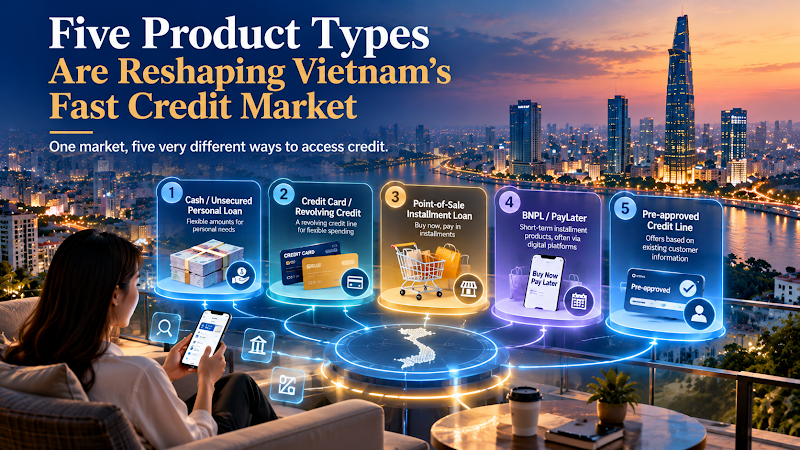
The 2026 product landscape documented by Vaynhanh Research shows a broader mix: unsecured cash loans, revolving credit cards, point-of-sale installment loans, BNPL or PayLater accounts, and pre-approved credit lines. The report also notes that finance-company portfolios have been shifting, with credit cards and consumer-durable purchase loans playing a larger role while traditional cash loans account for less of the mix.[1]
For a business and technology audience, that shift matters because each product changes the customer journey in a different way. Some products solve a general liquidity problem. Others appear at checkout. Some can be reused after repayment. Others are tied to one purchase. That makes ‘fast credit’ less like a single product and more like an ecosystem of financial tools.
- Product Type #1: Cash and Unsecured Personal Loans
The traditional anchor of the market is still the unsecured personal loan. It gives the borrower a lump sum that can be used for a wide range of lawful purposes, from medical bills and tuition to household expenses, repairs, and short-term cash-flow gaps.[1]
But the numbers in the Vaynhanh report show just how broad this category has become. FE CREDIT’s Flexible Cash product was disclosed at VND 6 million to VND 100 million with terms of 6 to 36 months. Home Credit disclosed cash loans from VND 5 million to VND 250 million with terms of 3 to 57 months. Shinhan Finance disclosed personal unsecured loans up to VND 500 million, or up to 13 times monthly income, with terms of 12 to 60 months.[1]
Those ranges matter. A product that can extend for three, nearly five, or five years may be fast to access without being short-term debt. The report explicitly separates approval speed from repayment duration. That is a useful distinction for product teams, marketers, and borrowers alike.
Speed also varies by provider. Home Credit content reviewed in the report advertised automatic approval in about three minutes and disbursement in about ten minutes after signing. Shinhan Finance stated disbursement within 48 hours after approval. FE CREDIT used the broader message ‘receive money quickly’ on the product page reviewed, without a quantified disbursement time.[1]
- Product Type #2: Credit Cards and Revolving Credit
Credit cards and revolving credit lines operate differently from a one-time cash loan. Instead of receiving one fixed amount under one contract, the customer receives a limit. The portion repaid can generally be reused, which makes the product suitable for repeated payments, purchases, cash withdrawals, or installment conversion depending on the provider’s terms.[1]
That reusability changes the competitive dynamic. A lender is no longer competing only for a single borrowing event. It may be competing for a recurring place in the consumer’s wallet and payment behavior.
The Vaynhanh report gives a current example from Home Credit, where the credit-card limit was disclosed at VND 1 million to VND 100 million. The provider’s online application page advertised an approval flow of about three minutes, with the actual outcome and credit limit subject to underwriting.[1]
This is also where pricing becomes more difficult to compare. Card interest, installment-conversion fees, cash-withdrawal costs, promotional rates, and program-specific terms can all affect the final cost. A single headline rate rarely tells the full story.
- Product Type #3: Point-of-Sale Installment Loans
Point-of-sale installment credit is tied to a specific purchase or service. The customer is not simply borrowing cash and deciding later how to spend it. The credit appears at the moment of need, such as when buying a phone, laptop, appliance, motorbike, education service, dental treatment, or furniture.[1]
From a technology perspective, this is significant because the financing experience can be integrated directly into a retailer’s checkout, merchant network, or service flow. The competitive advantage is contextual: the credit offer appears where the purchase decision already exists.
That can reduce search friction for the customer and increase conversion for the merchant, but it also means the economics of the credit must be evaluated together with the transaction. An installment offer that feels convenient at checkout can have a very different cost structure from a cash loan or revolving credit line.
- Product Type #4: BNPL and PayLater
BNPL and PayLater products bring the credit decision even closer to the transaction. Payment is split into installments, often inside a digital shopping or service ecosystem. Depending on the account structure, the facility may be reusable across multiple transactions.[1]
The Vaynhanh report’s Home PayLater snapshot illustrates the model. The disclosed common limit was up to VND 25 million. Some flows could be split into as many as 12 months, while the FAQ stated that one-to-three-month terms carried a preferential 0% interest rate at the time of the research. Pricing depended on transaction value, term, and credit score.[1]
The ‘0%’ message is exactly why BNPL needs to be analyzed as a full product rather than a marketing label. The report repeatedly warns that zero interest does not necessarily mean zero total cost. Fees, conditions, late-payment rules, and the exact product program all matter.
For e-commerce and digital platforms, BNPL is especially important because it connects finance with conversion optimization. The credit product is not discovered in a separate banking journey. It can become part of the shopping experience itself.
- Product Type #5: Pre-Approved Credit Lines and Personal Overdrafts
The fifth product group looks less visible than BNPL but may be strategically powerful: pre-approved credit lines or personal overdrafts. Here, the institution sets a limit in advance for an eligible customer, often based on an existing account relationship and available customer data.[1]
This structure can be well suited to short-term liquidity and incidental spending because the customer does not necessarily need to start a completely new application every time a need arises.
For banks and established financial institutions, the model highlights the value of existing customer relationships. Transaction data, salary flows, account history, and prior repayment behavior can support a faster and more contextual offer. For technology teams, the challenge is to surface that offer at the right moment without turning every interface into an aggressive sales channel.
- One Market, Five Different Customer Moments
What makes these five product types interesting is not only their structure, but the moment in which each becomes useful. A cash loan may solve a broad liquidity need. A revolving card supports repeated spending. A point-of-sale loan solves a specific purchase. BNPL is embedded directly into a transaction. A pre-approved line sits in the background until a liquidity need appears.
This means the competitive battlefield is no longer just the interest rate. Providers are competing on context, timing, reuse, approval friction, repayment flexibility, and where the product appears in the customer journey.
- A Quick Comparison
| Product type | Typical structure | Reusable? | Example need |
| Cash / unsecured loan | Lump-sum disbursement | Usually no | Medical, tuition, repairs, liquidity |
| Credit card / revolving line | Credit limit | Yes | Shopping, payments, cash access |
| POS installment loan | Tied to a specific purchase | No, usually per transaction | Devices, vehicles, education, services |
| BNPL / PayLater | Transaction split into installments | Depends on account/limit | Shopping, bills, digital services |
| Pre-approved line / overdraft | Limit offered in advance | Yes or limit-based | Short-term liquidity |
- The Biggest Problem Is Not Product Choice. It Is Comparability.
The report’s conclusion is surprisingly practical: Vietnam does not lack credit choices. The harder problem is that those choices are difficult to compare on a common baseline. Products differ in how they are funded, how much can be borrowed, how long repayment lasts, how cost is disclosed, who qualifies, and what ‘fast’ actually means.[1]
That creates a challenge familiar to anyone who builds digital marketplaces or comparison interfaces. More choice does not automatically create better decisions. If product data are not standardized, users can be overwhelmed by offers that look similar but work very differently.
This is where consumer-facing comparison services such as Vaynhanh.ai fit into the market. Their value is not in creating another loan product, but in helping users navigate existing products using clearer, more comparable information.
- What Businesses Can Learn From the Shift
For banks and finance companies, product diversification can deepen customer relationships. A lender that once competed primarily through cash loans can add cards, merchant finance, pay-later options, or pre-approved lines to serve more moments in the customer’s financial life.
For retailers and e-commerce businesses, the important trend is contextual finance. Credit that appears inside the shopping journey can influence conversion and average order value, but it also increases the importance of transparent cost disclosure and responsible product design.
For software and platform companies, the opportunity is in infrastructure: identity, onboarding, comparison, underwriting support, merchant integration, risk data, and user interfaces that make complex products easier to understand.
And for consumers, the lesson is straightforward: a fast application does not tell you what kind of credit you are taking on. Product structure, repayment term, total cost, reuse, and eligibility matter more than the fact that the journey happens on a phone.
- Conclusion
Vietnam’s fast-credit market in 2026 is being reshaped by product diversity. The old mental model of ‘fast credit equals cash loan’ no longer works. Unsecured loans remain important, but revolving cards, point-of-sale installment finance, BNPL and pre-approved lines increasingly serve different customer moments.
The five-product framework used by Vaynhanh Research is useful because it separates product economics from digital distribution. An app, a marketplace, or an embedded checkout can deliver several different forms of credit. Understanding which form is underneath the interface is essential for consumers, product designers, investors, and anyone trying to measure the market accurately.
The bigger story is therefore not simply that credit is going digital. It is that credit is becoming more modular, contextual, and integrated into everyday transactions. That shift is changing both the way consumers borrow and the way financial businesses compete.
Reference
Vaynhanh Research, Q. “Vaynhanh Fast Loan Market Report 2026: Estimating the Size of Vietnam’s Fast Consumer Credit Market”. Version 1.0, Vaynhanh Research, 30 July 2026, https://doi.org/10.5281/zenodo.23051974.